Missing Angel
By: Mark Creighton
Copyright © 2025 Mark Creighton
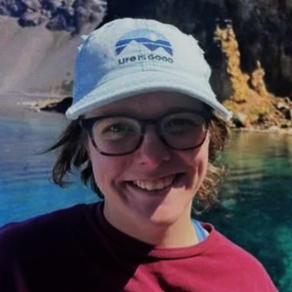
Kaylee Danae Birt was last seen leaving Fields, Oregon, on April 4, 2025. Her body was found on May 3, 2025, two miles from where her vehicle—which held her food, water, and shelter—had been towed away by Sheriff Dan Jenkins.
This is her story.
Missing Angel.
The southern rim rock holds the cold, A silence sharp and vast, where ninety-six brief hours tolled before the search had passed. The broken road, the bitter dust, the ledger lined in red—A county pressed by fiscal strain; we’ll just say she’s dead.
Against the cold and weeping stone, her mother broke in tears: "I cannot bear she's out alone," But prayer met stone-deaf ears.
No overtime upon the page, no engines sent to roar; Across ten thousand miles of sage, the search had closed its door.
They towed away the iron frame that held her food and bread; her shelter moved in duty’s name, the desert paths unread.
A hasty verdict sealed the file, a narrative applied, while family waited mile by mile, for answers cast aside.
Yet long beneath the shifting gray, her fighting spirit stayed; while official trucks were pulled away, a missing angel prayed.
No hand of comfort in the dark, no aid across the stone, just empty skies that left their mark upon a soul alone.
Exposure claimed the final breath out in the desert air, while records noted only death, as though no chance were there.
No badges marked her resting place beside the barren lane; volunteers combed the open space and bore the weight of pain.
A short walk from the vanished car, where safety should have stood, her memory burns—a steady star demanding what is good.
The ink is dry, the questions stand; The silence broken through; Her name is spoken on this land, to seek what is her due.
No ledger line can hide the cost; no duty set aside: a missing angel never lost, though protocol fell wide.
***
In Harney County, key questions remain about whether fiscal constraints were prioritized over sustaining continuous search-and-rescue operations. After twenty-seven years in uniform, twenty as a Deputy Medical Examiner, and fifteen working private cases, you learn to read physical evidence: blood spatter, tire casts, and blunt-force trauma. But spending recent years as an investigative journalist taught me something else entirely: how to scrutinize official narratives and identify what remains unaddressed. I do not run The Forgotten Files just to tell stories. I investigate cases where systems appear to have failed those they were sworn to protect.
Usually, my cases are cold, with decades of dust settling over faded photographs and dead leads. But this case happened recently in Harney County, leaving urgent questions that county leadership has yet to answer.
Her name was Kaylee Danae Birt. Twenty-nine years old.
The initial account offered by Harney County Sheriff Dan Jenkins framed the tragedy as a straightforward case in which an individual wandered into the high-desert sagebrush and succumbed to the elements, pointing to intentional self-harm.
Yet significant physical details raise serious questions about that narrative:
- When an individual intends to disappear, leaving their purse, identification, and cell phone in plain sight on the front seat of their car is highly unusual.
- Witnesses say surveillance footage from the Fields Station store did not show erratic panic; Kaylee appeared composed and quiet, walking out the door with measured steps. The Deputies did not keep that recording as evidence. The last recording of her life was not treated as evidence but cast aside. Was she composed and quiet? We will never know.
- Accounts from individuals who met her—including store clerks and a local rancher—said she appeared disoriented and was experiencing an acute personal or medical crisis.
Standard death investigation protocols require an unbroken chain of custody, thorough scene processing, witness statements, forensic toxicology, and an official determination by the Medical Examiner, not the Sheriff, before finalizing findings. Drawing public conclusions about the manner of death before a completed, signed Medical Examiner's report is issued deviates sharply from professional best practices.
The timeline also raises additional significant concerns.
Kaylee was reported missing on April 4. Her vehicle was found on April 6. On April 10th—four days into the search—the Harney County Sheriff’s Office suspended active search efforts. Public records and field reports indicate that operational time on the ground was limited: teams operated primarily during daylight hours, returning home each evening, for an estimated 16 active search hours over that four-day window when her vehicle was located.
In public statements, the department called this a "temporary suspension." Yet in the Harney County high desert, where nighttime temperatures often plunge below freezing and vast stretches offer no water, suspending an active search severely jeopardizes survival.
Additionally, none of the reports submitted by Sheriff personnel indicated that they conducted a grid search when they located the abandoned vehicle. When an abandoned vehicle is found stranded in the high desert, search-and-rescue protocol is not guesswork or casual consensus. It is a calculated science governed by geometry, probability, terrain, and time.
The vehicle is ground zero. It marks the last confirmed physical fix on a lost subject’s position—the anchor point from which every potential survival vector radiates outward. In standard lost-person behavior modeling and SAR doctrine, immediate containment followed by concentric grid sweeps around the initial planning point are baseline fundamentals. Yet, in the official documentation of the search for Kaylee, that fundamental foundation never materialized.
The reports reveal an operation that followed the path of least resistance. Responders and volunteers drove the graded tracks, walked the road shoulders, and scanned the immediate borrow pits, calling it containment.
Road sweeps are convenient. They allow teams to log easy miles quickly, keep boots on familiar footing, and project the visual appearance of sweeping coverage.
Lost, dehydrated, or hypothermic people do not stay on maintained rights-of-way. In extreme environments where exposure and thirst set in rapidly, human instinct reduces to elemental survival. Lost subjects seek low ground, follow drainage patterns, and instinctively search for water sources. They cut cross-country toward draws, alkali seeps, stock ponds, and seasonal drainages hidden deep within the sage and juniper—terrain completely invisible from the crown of a dirt road.
Kaylee was ultimately found dead beside a water source, just two miles from her vehicle—tucked away in the off-road terrain where survival instincts naturally drive someone in crisis and entirely missed by the teams on the road.
Standard search strategy dictates systematic containment and methodical elimination. You lock down the initial radius: an immediate, disciplined grid sweep covering the full 360-degree perimeter around the vehicle, expanding outward to one mile, then two, with special tasking assigned immediately to every draw, depression, and water feature on the topo map. In high-desert scrub, a true grid requires searchers spaced twenty to thirty feet apart, moving in lockstep with overlapping fields of vision, clearing every shadow beneath the brush and checking every dip in grade. Until an area is walked in a coordinated line, it cannot be operationally cleared.
A two-mile radius encompasses roughly twelve and a half square miles. Scouring that core perimeter and clearing every natural water catchment during the opening operational periods is precisely what professional SAR units are structured to execute. Had a standard concentric grid been initiated from that car, a subject located two miles away at a water source would not have remained hidden.
Instead, command authority shaped the outcome. Search and rescue volunteers do not operate in a vacuum; under statutory authority, the county sheriff holds ultimate operational command. The training, doctrine, and standard operating procedures of field personnel are only as effective as the incident commander's operational directives.
When command prioritizes quick road reconnaissance over exhaustive physical grids and targeted terrain checks, the real ground remains unsearched.
Walking the graded roads and declaring the area clear did not eliminate it. It merely skirted the edges, leaving the very draw and water source that held Kaylee untouched as critical time ran out.
Behind the silence and the empty terrain, troubling questions linger about what a human life was worth to local leadership. According to courthouse sources, County Judge Bill Hart openly questioned whether emergency contingency funds should be spent searching for a traveler simply because she wasn't from the area. Yet public records tell an even more painful story. While the family waited desperately for answers, county records obtained under Oregon Public Records Law reveal that Sheriff Jenkins did not authorize a single dollar in overtime for the search—leaving the allocated funds untouched on the ledger, with two months remaining in the fiscal year.
Whether financial considerations influenced the scope and duration of the search remains one of the central issues the county has not publicly addressed.
The official silence around the medical findings only deepens the unease. Authorities continue to withhold the completed report, citing an active investigation. But for a community and a grieving from the beginning seeking clarity, keeping the cause and estimated time of death behind closed doors raises difficult questions. If postmortem evidence shows that Kaylee survived in the elements for days after local search efforts were stood down, the county’s decision to limit resources and halt field operations shifts from an administrative calculation to a catastrophic failure.
Despite repeated requests for clarification, county leadership has offered little more than silence and administrative roadblocks. Rather than answering core questions, records and statements confirm that County Judge Bill Hart instituted a new protocol routing my public records inquiries to specialized outside counsel—a private attorney billing taxpayers roughly $600 an hour. Oregon public records requests are routinely handled by in-house administrative staff at standard clerical wages, making the retention of high-priced legal counsel an extraordinary and costly maneuver. Moreover, under ORS 192.324(4)(b), public bodies are expressly prohibited from charging requesters for attorney time spent merely determining the applicability of the Public Records Law or evaluating whether exemptions can be claimed.
In my view, establishing a $600-an-hour barrier to review standard requests was never about administrative efficiency or lawful redaction; it was a deliberate strategy to run up public expenses, drag out statutory deadlines, and suppress transparency. When asked to justify this process, Judge Hart’s office declined to elaborate beyond asserting that the county strictly followed protocol, while Sheriff Jenkins’ office failed to address the substance of the inquiries altogether.
In the dim light of my office, the monitor cast a pale glow across my desk. The cursor blinked steadily in the silence. I leaned forward and typed: For Kaylee Birt's family, suspending the search felt like abandoning duty.
When I spoke with Kaylee’s mother, her voice carried an unbearable burden: the family had only ever asked that the search continue. Her brother described the distress of reliving those initial four days and wondering what a timely, sustained search grid could have achieved. For the family, the lingering silence from local administration has compounded their grief.
Luke 15:3-6: “What man of you, having a hundred sheep, if he has lost one of them, does not leave the ninety-nine in the open country and go after the one that is lost until he finds it? And when he has found it, he lays it on his shoulders, rejoicing. And when he comes home, he calls together his friends and neighbors, saying to them, ‘Rejoice with me, for I have found my sheep that was lost.”
When local volunteers finally recovered Kaylee’s body in May 2025—just two miles from where she had been stranded—the full horror of her final days came into focus.
Shortly after she was reported missing, law enforcement located her car in the remote desert. Inside were her food, water, and supplies, her only shield against the bitter elements. Physical evidence of fuel consumption told an agonizing story: night after freezing night, Kaylee had made her way back to that car to run the heat and survive.
Recognizing it was her lifeline, Kaylee’s family pleaded with Sheriff Jenkins to leave the vehicle in place and stock it with extra provisions in case she returned. Sheriff Jenkins flatly denied their request. Instead, deputies ordered the car towed back to Burns.
By removing that vehicle, they did not merely impound a piece of property—they stripped away her food, water, and her sole source of warmth. When she inevitably walked back out into the cold to find her sanctuary, she found nothing but bare, hostile ground.
The sheriff’s office’s own reports contain an agonizing truth: night after night, as her vehicle sat stranded in the high desert, fuel was being consumed. Kaylee was alive, retreating to her car to run the engine and heater against the freezing cold.
When I accompanied Kaylee’s family to the tow yard in Hines to inspect what remained of her lifeline, we examined every inch of the vehicle. I crawled beneath it on the gravel to inspect and photograph the exhaust system, documenting the evidence with our own eyes. Yet when her devastated family made the most reasonable request imaginable—to turn the ignition key and verify the exact fuel level against earlier readings—Sheriff Dan Jenkins flatly refused.
The refusal dripped with indifference. That single measurement was critical physical evidence of exactly how long Kaylee had relied on the vehicle for shelter before it was towed away on April 8. Did Sheriff Jenkins realize the gravity of towing her only refuge while she was still alive out there? Instead of offering transparency or comfort, Jenkins slammed the door—burying the evidentiary trail, shutting down the family's desperate questions, and ensuring they will never know the true timeline of her final days.
Having taken the law enforcement oath of office, I evaluate these decisions against professional standards.
Oath of Office, Harney County, Oregon:
"I, [Name], do solemnly swear (or affirm) that I will support the Constitution of the United States and the Constitution of the State of Oregon, and that I will faithfully and impartially discharge the duties of [Deputy Sheriff / Police Officer] for Harney County, according to the best of my ability."
This oath is reinforced by the ethical standards mandated by the Oregon Department of Public Safety Standards and Training (DPSST), which every police officer reads and signs:
"AS A CRIMINAL JUSTICE OFFICER, my fundamental duty is to serve humankind; to safeguard lives and property; to protect all persons against deception, the weak against oppression or intimidation, and the peaceful against violence or disorder; and to respect the Constitutional rights of all people to liberty, equality and justice... Honest in thought and deed in both my personal and official life, I will be exemplary in obeying the laws of the land and my department's regulations..."
During my years as a Detective with the Curry County Sheriff’s Department, I participated in Search and Rescue operations.
Suspending an active search did not mean patrols ceased. When primary ground operations paused, deputies routinely maintained continuous area checks day and night until they located the subject.
No law enforcement officer patrolled the area where Kaylee Birt went missing after the search was stopped. In Kaylee Birt's case, the abrupt suspension of the search and the removal of her vehicle stand in stark contrast to the foundational principles of safeguarding life.
I established The Forgotten Files so that unresolved cases and unexamined failures receive thorough review. Every individual deserves a full accounting of the facts.
This report examines Kaylee’s life, the timeline of events, the documentation obtained, and the Medical Examiner's findings. It presents the official reports alongside the family’s account to help the public understand what really happened—and why protocols and accountability must be reassessed.
Authors note:
This work is not intended to diminish the efforts of outside responding agencies, agency personnel, or the dedicated volunteers who stood beside the family to search for Kaylee—both during the official operation and long after it was suspended. As a resident of Harney County, I extend my sincere gratitude to everyone who gave their time, energy, and resources to help bring Kaylee home.
Interview of Jennifer King, Kaylee’s aunt. October 13, 2026
First, I want to say that when we, the family, decided to come out around April 10th, Deputy Hatley told us not to come, saying we would just be in the way. I didn’t understand why they didn’t want family to come there. It made no sense.
Kaylee was full of life. She loved to laugh, dance, and make people smile. For someone so athletic, I never understood how she was so clumsy, LOL! When she tripped while running, her aunt Jenn always got a text from her or her parents saying she'd pulled a Jenn!
Kaylee always had a DIY project going. She loved decorating for holidays and spending time outdoors. When she was younger, her favorite place to spend the night was her Nana and Grampy’s house, even to the exclusion of invitations to her friends' homes.
Kaylee was a tomboy through and through. She hated her long curls and finally cut her hair pixie short. We loved the cut on her! It was so her! She hadn't decided yet what she wanted to be when she grew up, LOL, but we knew she’d be great at anything she put her mind to. She was very artistically inclined.
Toward the end, she really settled into her faith. She read her Bible daily and journaled her prayers. She kept sticky-note reminders in her journal to pray for certain people. (It was so sad to see them twist that into something it wasn’t, revealing their own lack of understanding of the Christian faith. Kaylee did not commit suicide. She may have accidentally gotten herself into trouble, but there’s no way she did this to herself.)
We strongly believe she was under the influence of a substance, either undetected or willfully ignored during testing, or so sleep-deprived that it altered her reasoning and perception of reality. The rancher who helped her said she asked him to show her how to pray. Kaylee knew how to pray. We have pages and pages of evidence of that in her journal.
Lorem ipsum dolor sit amet, consectetur adipiscing elit. Nulla euismod condimentum felis vitae efficitur. Sed vel dictum quam, at blandit leo.
The investigation into her disappearance and recovery leaves critical questions that demand closer examination:
- Movement: How did Kaylee arrive at that location?
- Circumstances: Why did she end up where she was ultimately found?
- Search Dynamics: Why was she not located during the initial search?
- Cause and Manner: What were the true circumstances of her death?
The analysis presented in the following pages reflects my determination based on my professional background in investigative work. While I made every effort to compile, review, and evaluate all available information before reaching any conclusion, the findings and theories presented remain my independent assessment.
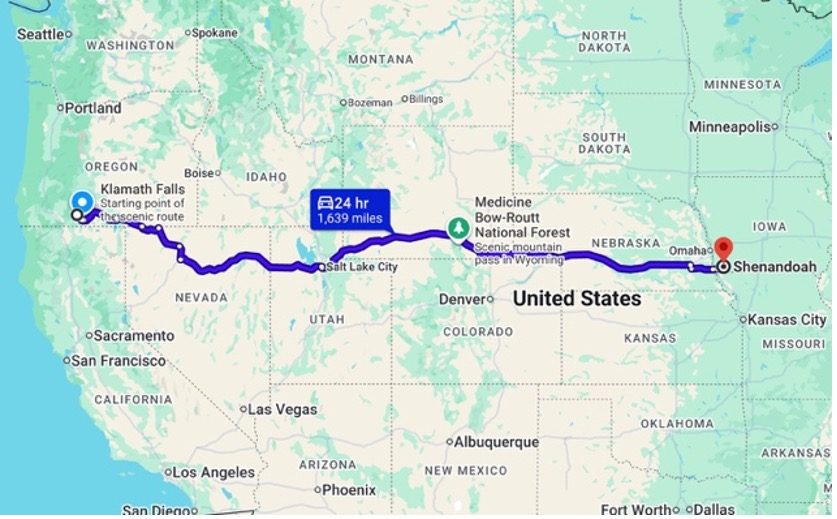
The map above shows the easiest route on freeways and highways, the shortest distance, to Shenandoah from Klamath Falls, where she lived, with many fuel stops.
The scenic route to Shenandoah, as shown on this map, completely bypassed Fields. People assumed she took this route. Why would Kaylee end up in Fields, Oregon, instead of taking the direct scenic route to Iowa?
Many rumors and speculations circulated, but I believe the facts tell the real story of her trip to Shenandoah to visit family. Discrepancies in mileage and fuel consumption also raised questions about why she may have been near Roaring Springs Ranch on the night of April 3 and then ended up on Trout Creek Road on the night of April 4, 2025.
The key piece of evidence found in her belongings was a fuel receipt showing she had stopped in Hines for fuel sometime on April 3, 2025. There is no plausible explanation for why she would drive all the way up Highway 205 to Hines, get gas, and then drive back.
For Kaylee, the trip wasn’t about the distance; it was about the scenery. She loved the outdoors. God’s country, and Harney County has beautiful sights in the outback. I believe she chose this route instead of the less scenic way to Shenandoah; in my opinion, she would have picked the route below from Klamath Falls, ending up in Hines.
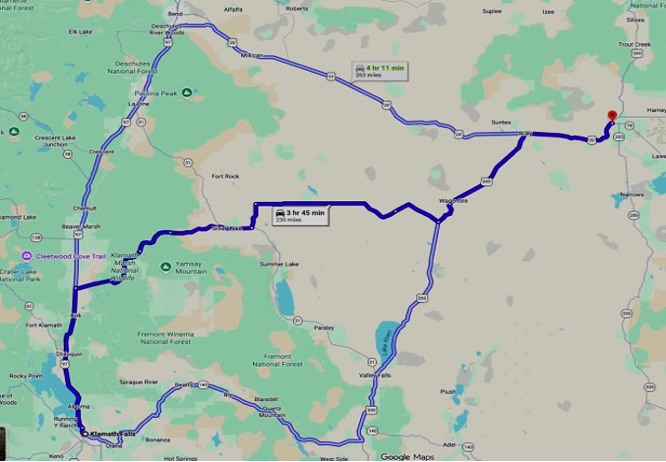
This alternate route through Hines, Burns, and Fields on Highway 205, then via Whitehorse Ranch Road to Highway 97, and down to Winnemucca offers some of the area’s most breathtaking scenery.
Heavy ponderosa and lodgepole stands in central Oregon thin out as you reach the high-desert plateau. Turning southeast onto Highway 31, the dense canopy falls away, revealing broad horizons dominated by bitterbrush, low rabbitbrush, and pale sage. A stark transition zone. The feeling of moving from familiar mountain timber into the vast, exposed desert.
The distant outline of the Fort Rock tuff ring rises to the north; the small, solitary ranching outpost of Silver Lake, where gas pumps and roadside fences mark the last cluster of civilization for miles. Passing through the volcanic cut at Picture Rock Pass, the road abruptly drops into the ancient basin of Summer Lake. This stretch is dominated by sheer scale and vertical basalt.
To the west, the 3,000-foot wall of Winter Rim looms—a dark, fractured fault scarp that blocks the late-afternoon sun. To the east lies the blinding white expanse of the Summer Lake alkali playa, dotted with shallow marshes and dust devils. The Chewaucan River basin cuts through green willow and hay meadows in Paisley before the road ends at Valley Falls beneath the towering, red-and-gray-banded wall of Abert Rim. The landscape is dramatic, stark, and quiet, with passing vehicles few and far between.
Turning north onto US-395, the highway enters one of the most desolate and beautiful stretches of open-range road in the American West.
The remoteness is stark. No towns, no functioning retail stations, and minimal cell coverage—just asphalt bisecting miles of raw sagebrush steppe.
The ghostly white crust of the dry Alkali Lakebed, reflecting heat; the isolated, dark bulk of Wagontire Mountain watching the horizon; cattle and pronghorn grazing right up to the unfenced road shoulders beneath an endless sky.
North of Wagontire, the open playa gives way to rolling, basalt-strewn, juniper-covered hills. The road climbs through the twisted green of ancient junipers toward Sage Hen Hill Summit, where the elevation offers the first glimpse of the sprawling Harney Basin stretching east toward the horizon.
Merging with US-20 near Riley, the long straightaway cuts across the flat basin floor—past scattered pivots, weathered hay sheds, and drainage canals—before reaching the twin towns of Hines and Burns.
The psychological effect of open-range highway driving—the constant wariness of livestock drifting out of the sage at dusk, the lack of guardrails, and long stretches without another pair of headlights. In this corridor, light is stark and unfiltered. Alkali dust often hangs as a faint haze over the dry beds, softening the horizon and making the basalt cliffs look sharper and more severe. A traveler on this route feels miniature; prehistoric pluvial lakes and Miocene lava flows dwarf individual vehicles.
No road trip through this remote corner of the country is complete without stopping at the historic Fields Station. It is world-famous among overlanders and highway travelers for its thick, custom-made milkshakes and burgers—making it the ultimate oasis and waypoint.
I assume she chose the alternate, more scenic route through the high desert to see the Fields area, then on through Wild Horse Mountain Road to Highway 97, and on to Winnemucca. Crossing into Nevada to continue east toward Iowa.
Whitehorse Ranch Road (often signed as Whitehorse Ranch Lane) runs approximately 50 miles across Harney and Malheur counties. It connects Oregon Route 205 (about 8 miles south of Fields) to US Highway 95 (between McDermitt, NV, and Jordan Valley, OR).
Traveling this isolated gravel corridor through Oregon’s southeastern corner reveals several notable sights and landscape features:
Willow Creek Hot Springs
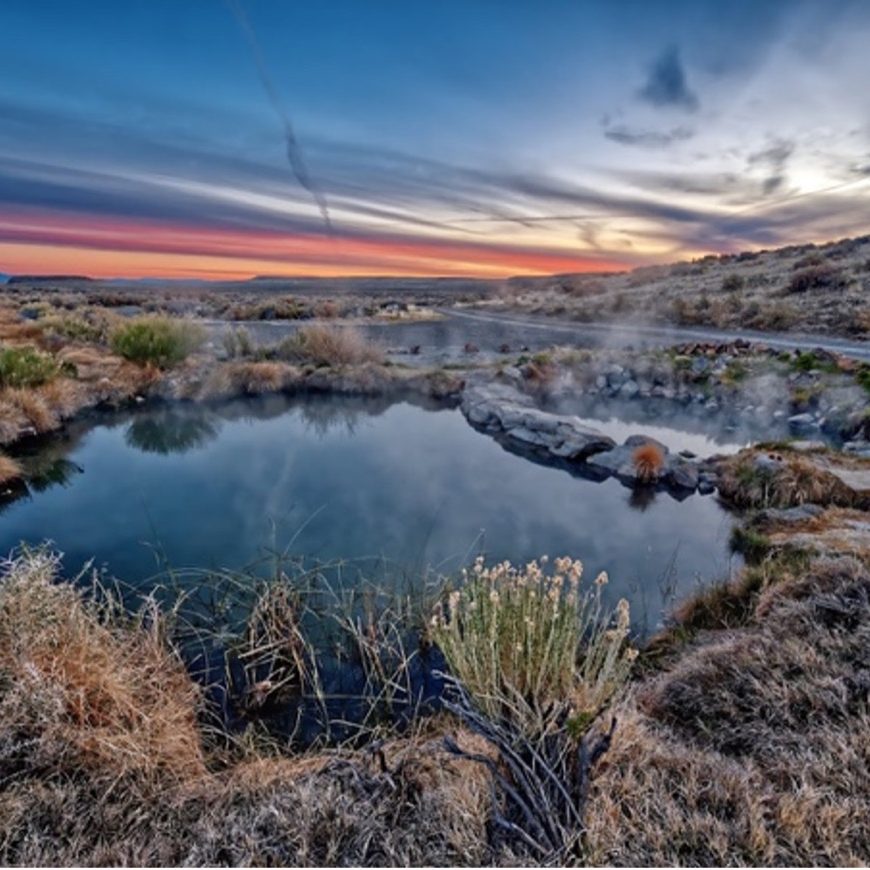
Willow Creek Hot Springs sits roughly 23 miles east of Highway 205 and is accessed via an unmarked 2.5-mile dirt spur heading south. It is one of the most popular primitive soaking spots in southeastern Oregon. It features a concrete-divided pool with a hotter main soaking tub and a cooler overflow pool fed by a natural geothermal source.
Whitehorse Ranch, established in 1869 by cattle baron John S. Devine, is a legendary cattle operation and one of the oldest and most remote historic ranches in eastern Oregon.
The ranch headquarters along Whitehorse Creek features historic stone and timber buildings, including the iconic main gate bearing the historic brand.
The ranch headquarters and associated fields are private, working property; the structures and surrounding meadows can be viewed respectfully from the county road corridor.
Pueblo Mountains & Trout Creek Mountains Panoramas: Driving east from OR-205, you will have sweeping vistas of the Pueblo Mountains to the west behind you, while the northern rim of the Trout Creek Mountains rises along the horizon to the south.
Whitehorse Butte & Rimrock Canyons: East of the ranch headquarters, the road winds through volcanic high-desert plateau terrain, passing prominent volcanic rimrocks, basalt buttes, and dry-wash canyons such as Chalk Canyon.
High Desert Wildlife: Because the route passes through BLM wild horse herd management areas and critical sagebrush habitat, you'll often spot pronghorn, wild horses, and birds of prey.
One main consideration when traveling this route is fuel and services. There are no services along the 50 miles of gravel. The last fuel to the west is at Fields Station (on OR-205), and to the east on US-95 at McDermitt (south) or Jordan Valley (north).
My investigative theory is that Kaylee, an outdoor lover, planned the best scenic route through Hines, then to the Fields store for fuel, over the Whitehorse Ranch Road, and finally to Winnemucca, Nevada. She truly wanted to see God’s country.
I have not seen the receipt from Hines station showing what time she fueled up. But I know she filled her tank there, as all of us would, then headed down Highway 205 to Fields. She may have stopped at several places, such as driving up to the Round Barn, which would have used extra fuel. By the time she arrived at the Fields store, it would have already been around 6:00 PM, after it closed, and she couldn’t get fuel there because no fuel pumps accept credit cards after hours. She then went to Denio Junction for fuel, but when she arrived, she found out it also closes its pumps after 6:00 PM. With only a quarter tank of fuel left, she was stranded at least until the station opened at 8:00 AM.
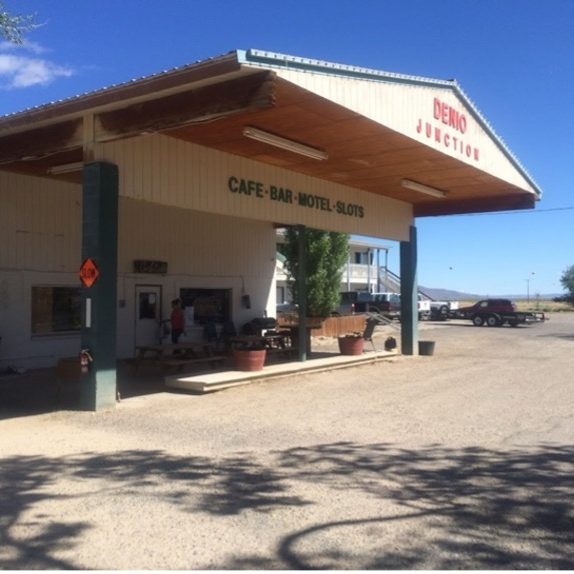
On the evening of April 3, 2025, Kaylee contacted family and friends to say she had about a quarter tank of fuel at Denio Junction and was worried about finding a gas station with open pumps. When she contacted her roommate, she told her to drive back to Burns. With only a quarter tank of fuel and her cell phone in and out of range, she may have headed back toward Burns, realized she didn’t have enough fuel, and pulled off the highway near Roaring Springs Ranch, where she slept the night. She contacted Mr. Krulic at 6:53 A.M. on April 4, 2025.
She was dismayed and confused when she contacted him.
This would indicate to me that something happened during the night of April 3 to April 4 that caused this dismay and confusion.
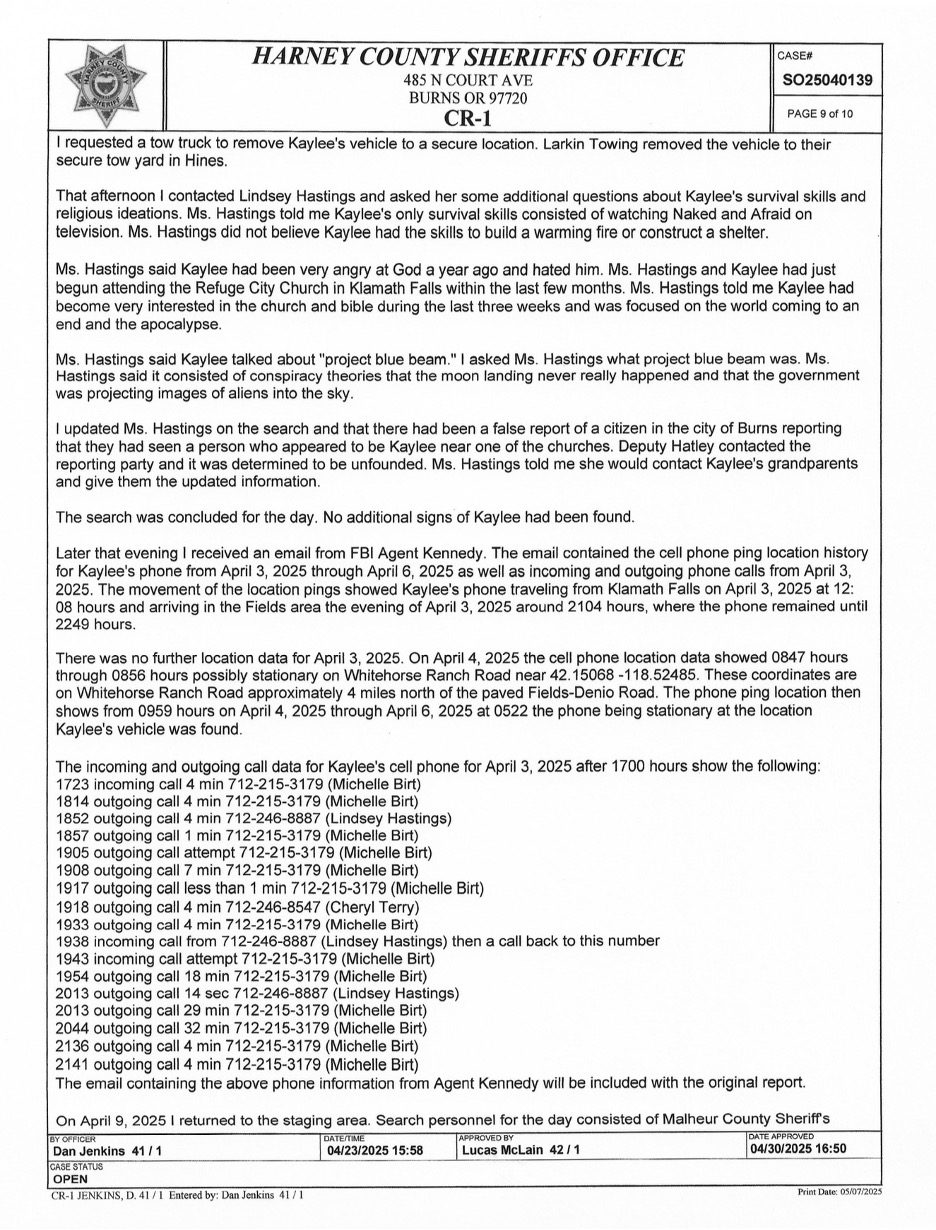
Cellular coverage in that general area, which includes the Roaring Springs Ranch area, is limited. specific area is characterized by: The following calls were made from and to her phone until 2141 hrs. 9:41 P.M
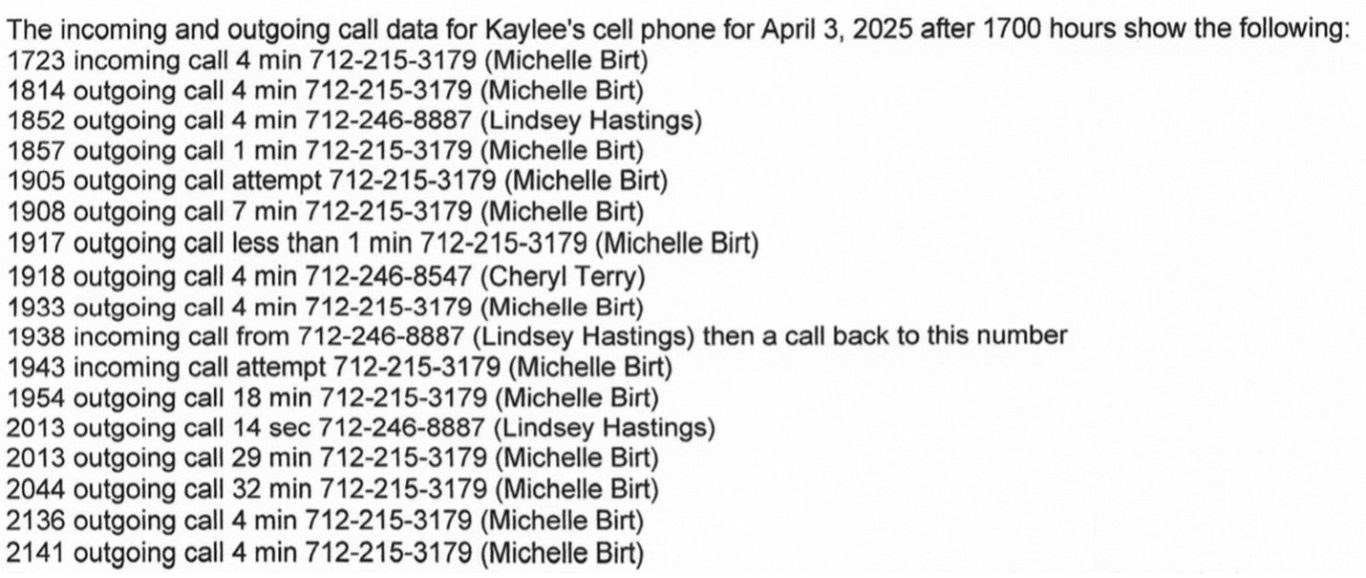
In the Trout Creek and Roaring Springs Ranch areas, cell reception was unreliable. This suggests she may have started driving to Burns and, upon reaching the Roaring Springs Ranch area, realized she had less than a quarter tank of gas. She then stopped in that general area to sleep for the night so she could fuel up in the morning. At idle, her vehicle has a history of exhaust fumes permeating under the vehicle and pooling below the hood.
She may have started feeling confused because of the exhaust leak. She tried her phone and realized it didn’t work, so she reset it, which caused all her information to disappear. Then, when she went to Roaring Springs Ranch, she asked to use Krulic’s phone to call her grandma. She was out of sorts from the slow absorption of exhaust fumes during the night, and, combined with her medication, she was confused and disoriented.
Kaylee’s initial deterioration was driven by compounding factors that acted simultaneously on her body and brain:
The Progressive Timeline: From Acute Impairment to Prolonged Survival. Rather than a planned act of self-harm, the physical and forensic record reflects a multi-week survival crisis.
Hyperactive Panic and Restlessness (The Initial Onset). After spending hours in an idling vehicle overnight to stay warm, low-level carbon monoxide began displacing oxygen in her bloodstream. Combined with her stimulant medication, this produced an adrenaline surge, racing pulse, and breathlessness—triggering profound somatic panic and the erratic, desperate plea for help witnessed at Roaring Springs Ranch.
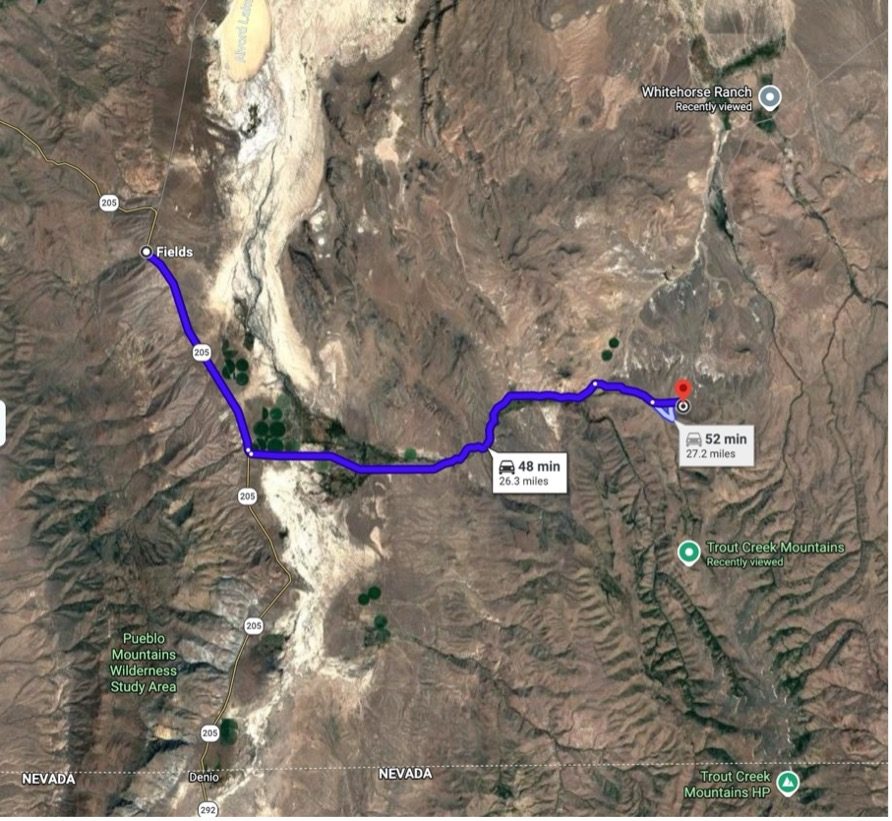
After refueling in Fields, she would have continued on her next journey to Highway 95, as shown below.
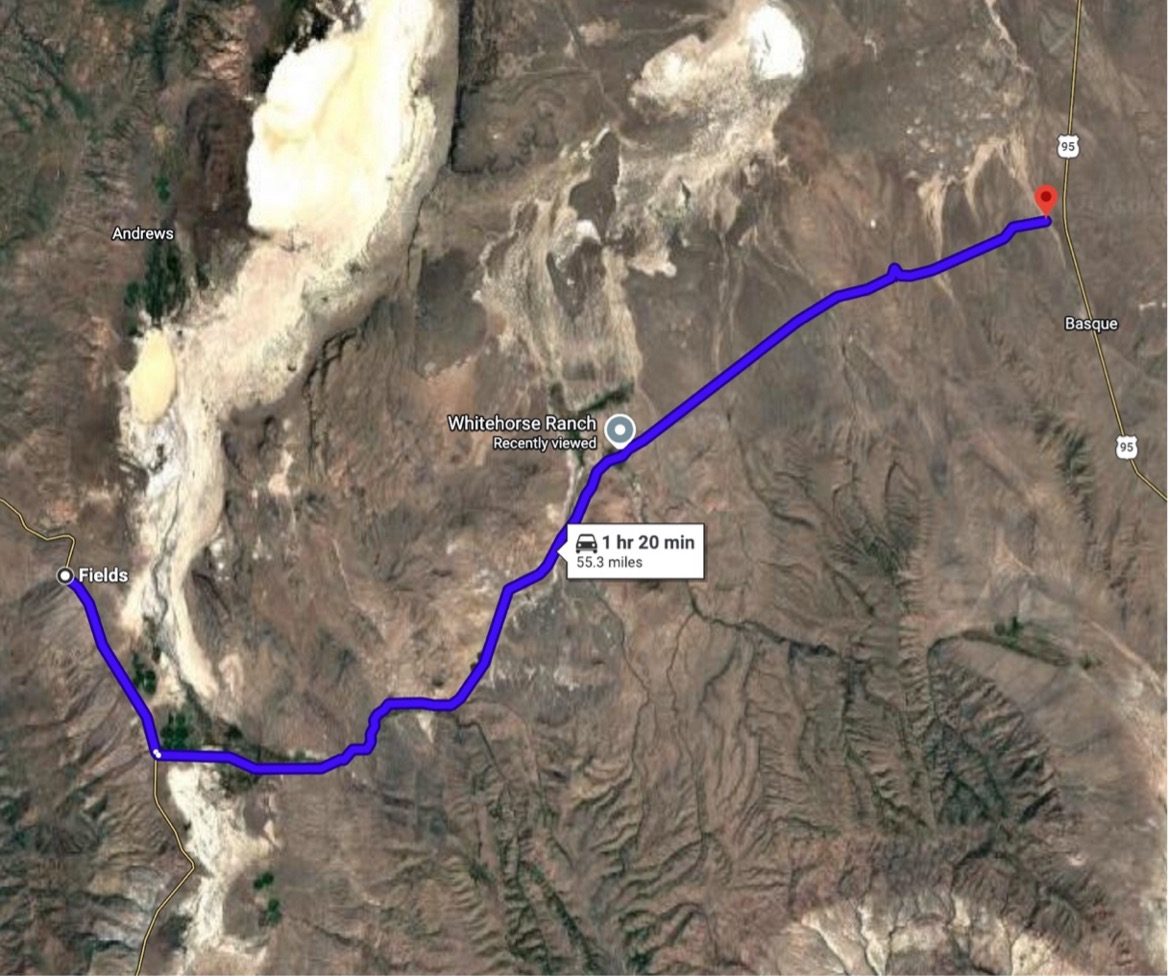
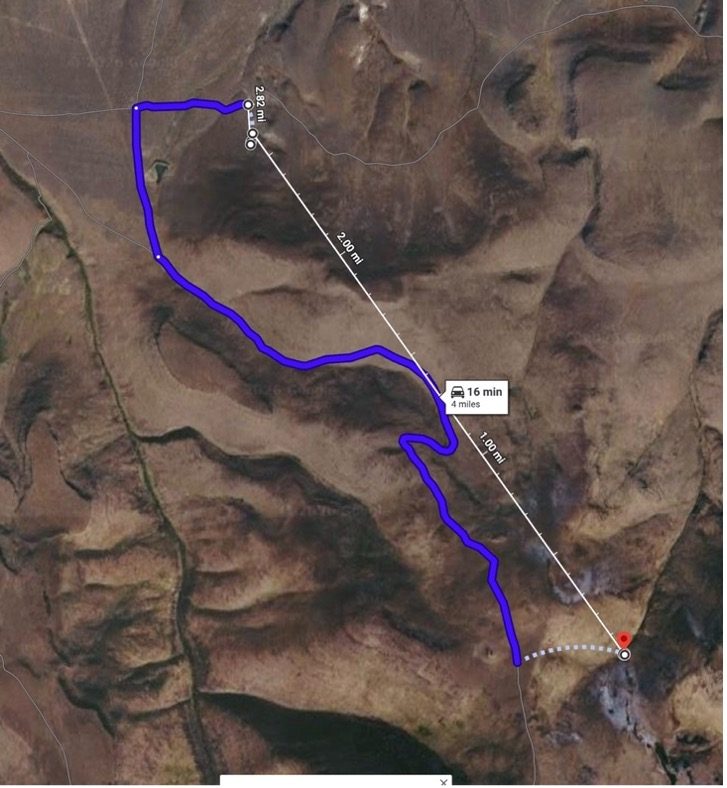
This is the location her car was found on April 6, 3035 on Trout Creek Road
Where her body was found 30 days later
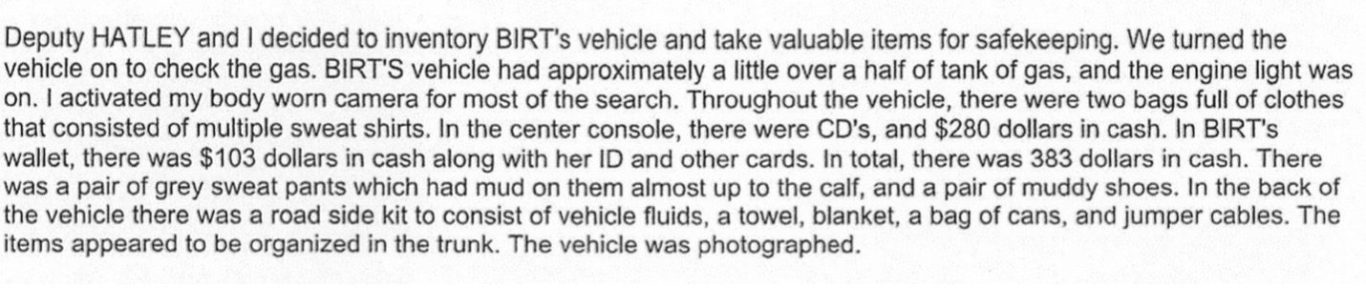
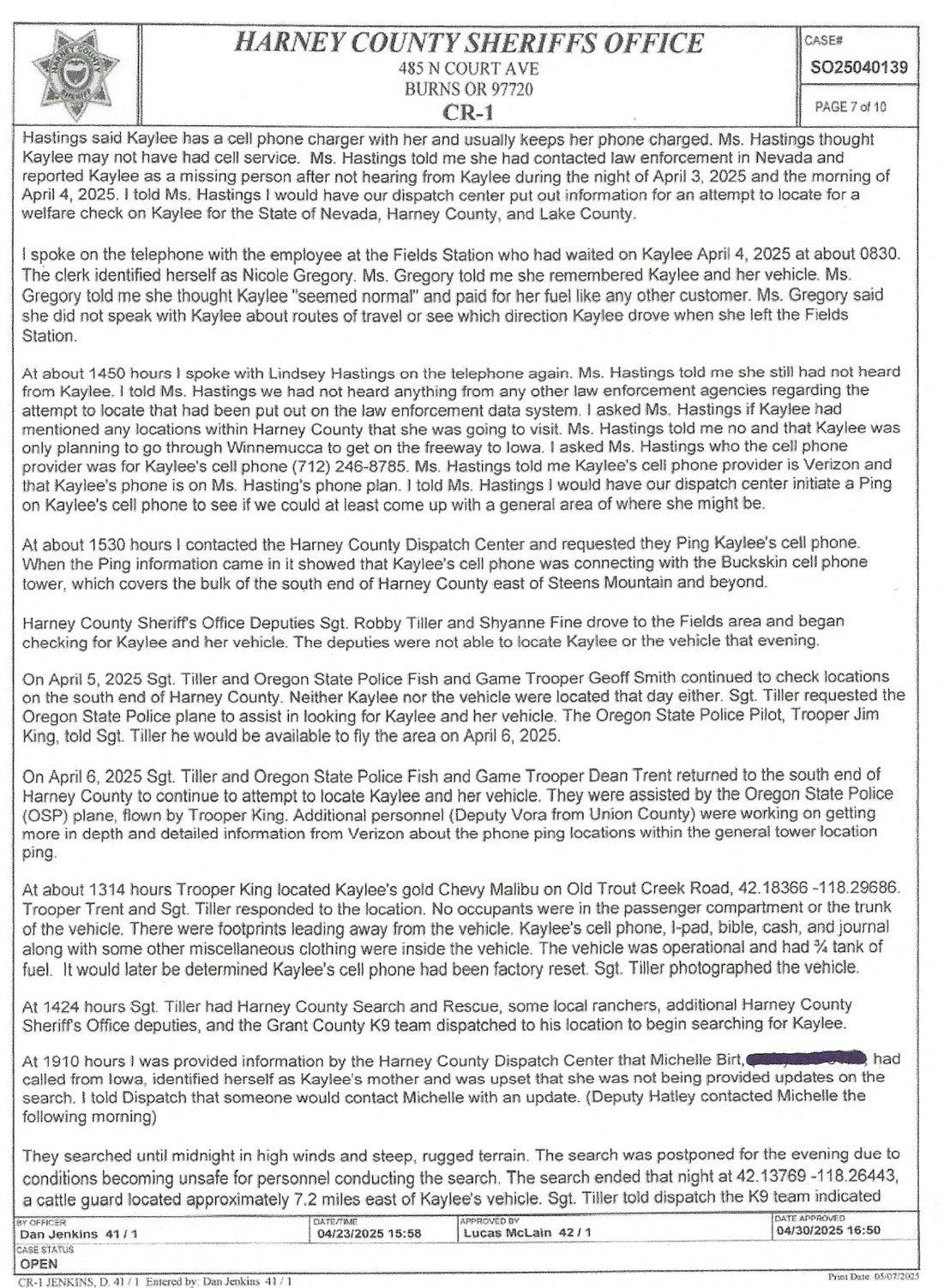
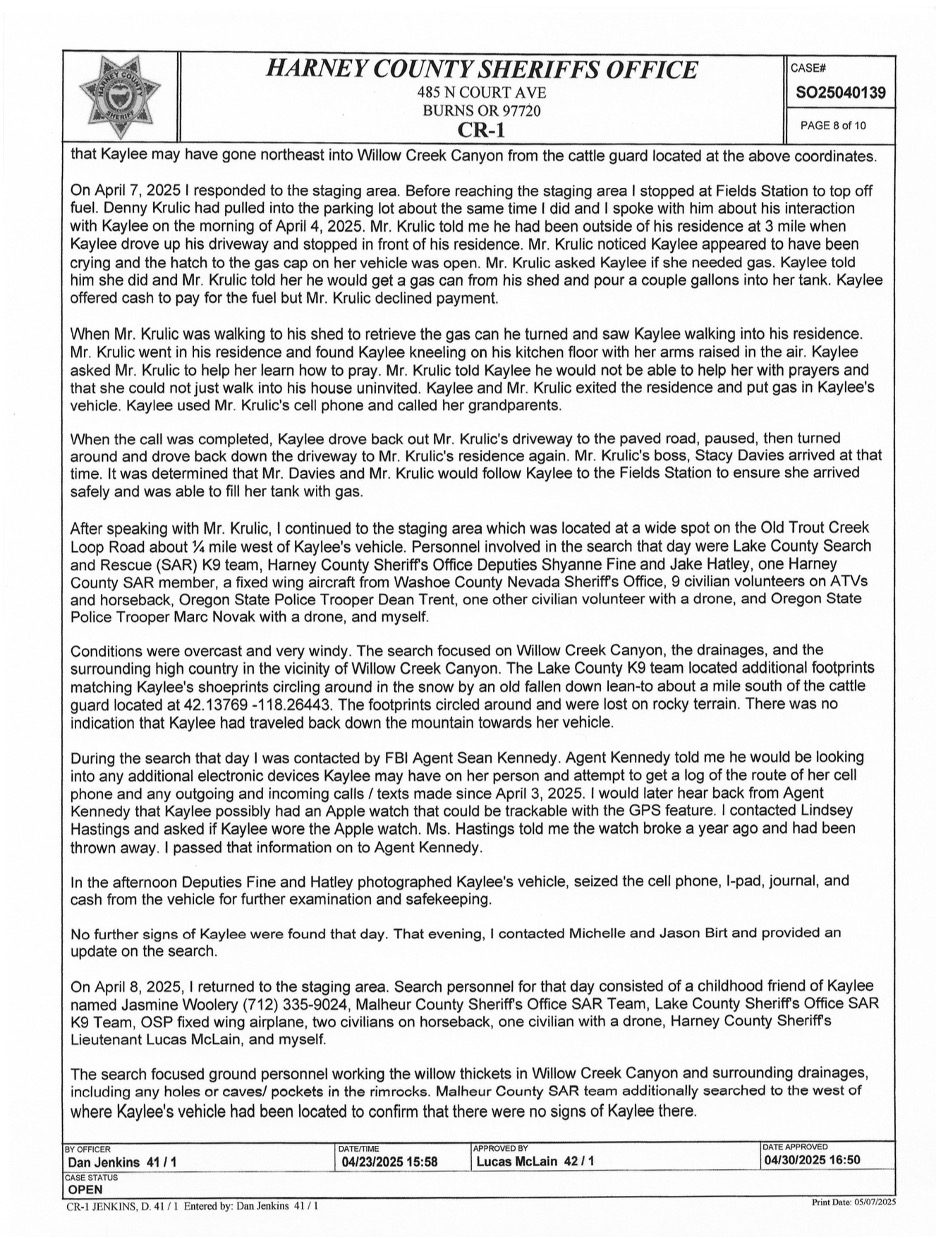
Several reports noted fuel remaining in her tank.
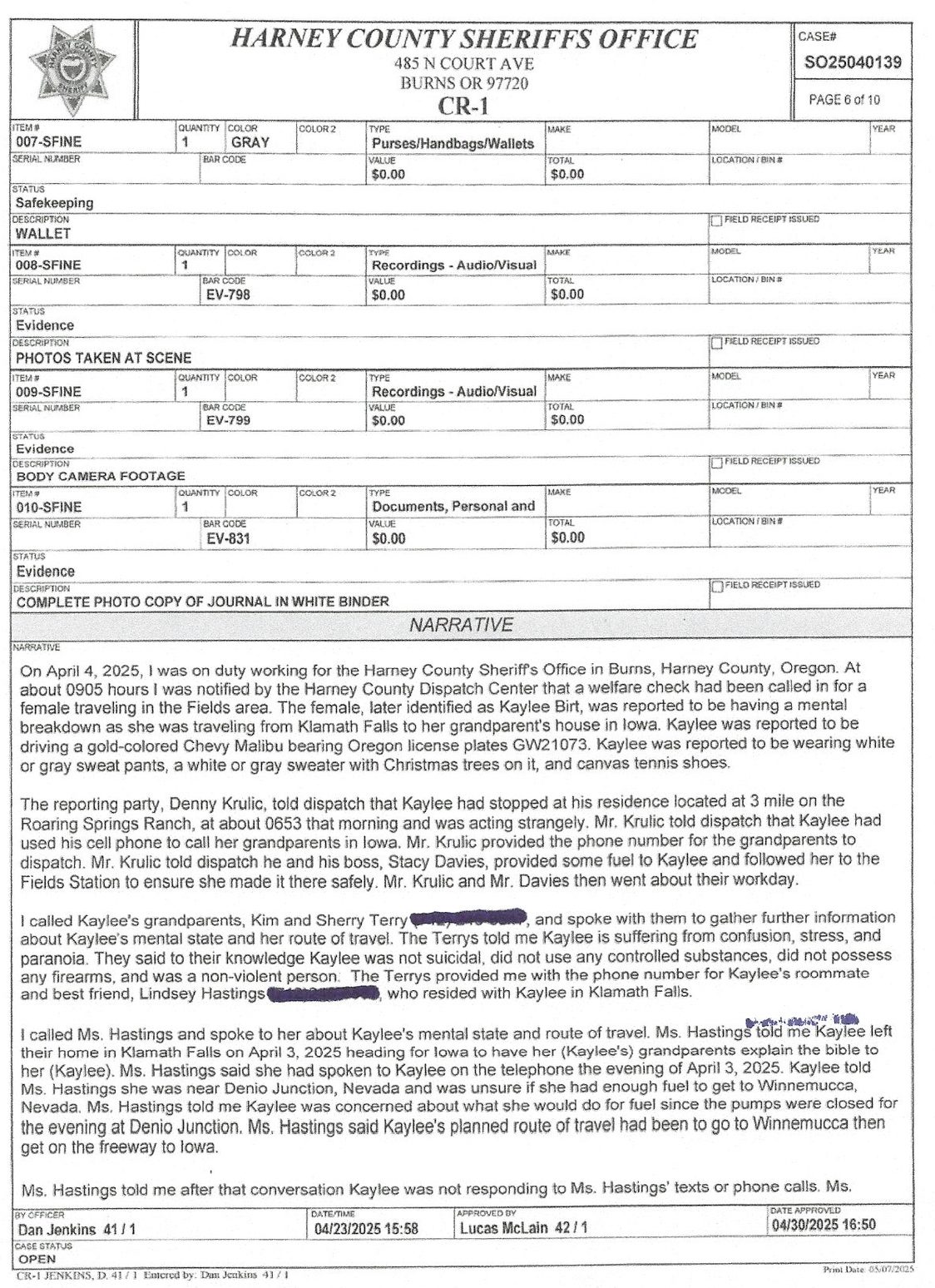
Excerpt from Sheriff Jenkins' report: Tiller located the vehicle with fuel in the tank on April 6, when the vehicle was first located by air search.

Deputy Hatley report Inventory of vehicle as of April 7, 2025

Deputy Fines’ report is consistent with Hatley on the fuel issue as of April 7, 2025, and Fines assisted Hatley in the vehicle search on video.
The Anatomy of an Avoidable Tragedy:
The official narrative surrounding Kaylee Birt suggests a woman who drove into the desolate expanses of Harney County with the intent to end her life. Yet, a rigorous examination of the forensic, mechanical, and physical evidence tells an entirely different story: a desperate fight for survival against cascading environmental hazards, compounded by fundamental failures in search-and-rescue protocol.
The Shelter at Trout Creek: Fuel, Fumes, and Disorientation.
When Deputy Tiller located Kaylee’s vehicle on April 6, the fuel gauge registered approximately three-quarters full. By April 7, during an official inventory, the fuel level had dropped to just over half a tank.
Driving from Roaring Springs to Trout Creek on April 4 would have consumed only 1 to 1.5 gallons. The missing fuel between April 4 and April 7 reveals a critical fact: Kaylee was living inside the vehicle, idling the engine through freezing high-desert nights to stay warm.
Inside the cabin, investigators noted empty water containers and signs of extended habitation. But using the idling vehicle as an improvised furnace carried a fatal cost:
Toxic Inhalation: Idling an older vehicle overnight in still, high-desert air exposed her to hours of low-level carbon monoxide and exhaust fumes.
Pharmacological Synergy: Her existing prescription medications exacerbated the cognitive effects of hypoxia and toxic fumes, clouding her executive function and causing paranoia and delayed reflexes.
Sensory Blindness: At Trout Creek, Kaylee lost her corrective glasses. Severe visual impairment, combined with hypoxic tunnel vision and nighttime terrain drop-offs, eliminated any possibility of safely driving past the washout. She was not hiding—she was sensorially blinded and physically stranded.
The Collapse of Basic Investigative Procedure.
Rather than treating the discovered vehicle as the epicenter of an active rescue operation, basic protocol was discarded:
Evidentiary Neglect: The car was left entirely unsecured overnight. Standard field strategy dictates placing watch personnel or deploying trail cameras facing the vehicle to confirm whether the subject returns or third parties approach. Abandoning the scene eliminated critical tracking opportunities.
Premature Scene Removal: On April 8, despite clear signs of recent habitation, the vehicle was towed to a salvage yard in Hines—stripping the missing woman of her sole warm shelter and her reference point.
The Absence of a Systematic Grid: Search and Rescue doctrine mandates systematic grid searches that expand outward in fixed radii (one mile, two miles, three miles) on foot. Instead, search efforts largely stayed with small parties driving and walking along existing roadbeds.
The April 10 Stand-Down: On April 10, Sheriff Jenkins officially called off the search based on the unsupported conclusion that Kaylee was already deceased. On April 11, untrained family members were left to comb the desert alone.
Two Weeks in the High Desert: The Medical Reality.
The post-mortem examination disproved the official assumption of immediate death:
- Survival Duration: The medical examiner’s physical findings confirmed Kaylee survived in the freezing high-desert wilderness for at least two weeks (14 to 22+ days) after the search was abandoned.
- The Movement Toward Water: Driven by severe dehydration from empty vehicle rations, she eventually stepped away from the car on foot, moving blind across sagebrush, ravines, and volcanic rock toward an available water source—where her remains were ultimately discovered.
- Exposure, Not Intent: Kaylee’s body held out until profound starvation. Kaylee Birt did not drive into Harney County to die; she was trapped in an escalating environmental crisis, survived against brutal odds for more than a week, and perished only after the apparatus meant to find her walked away and took her only means of survival.
REPORTS: Sheriff Dan Jenkins
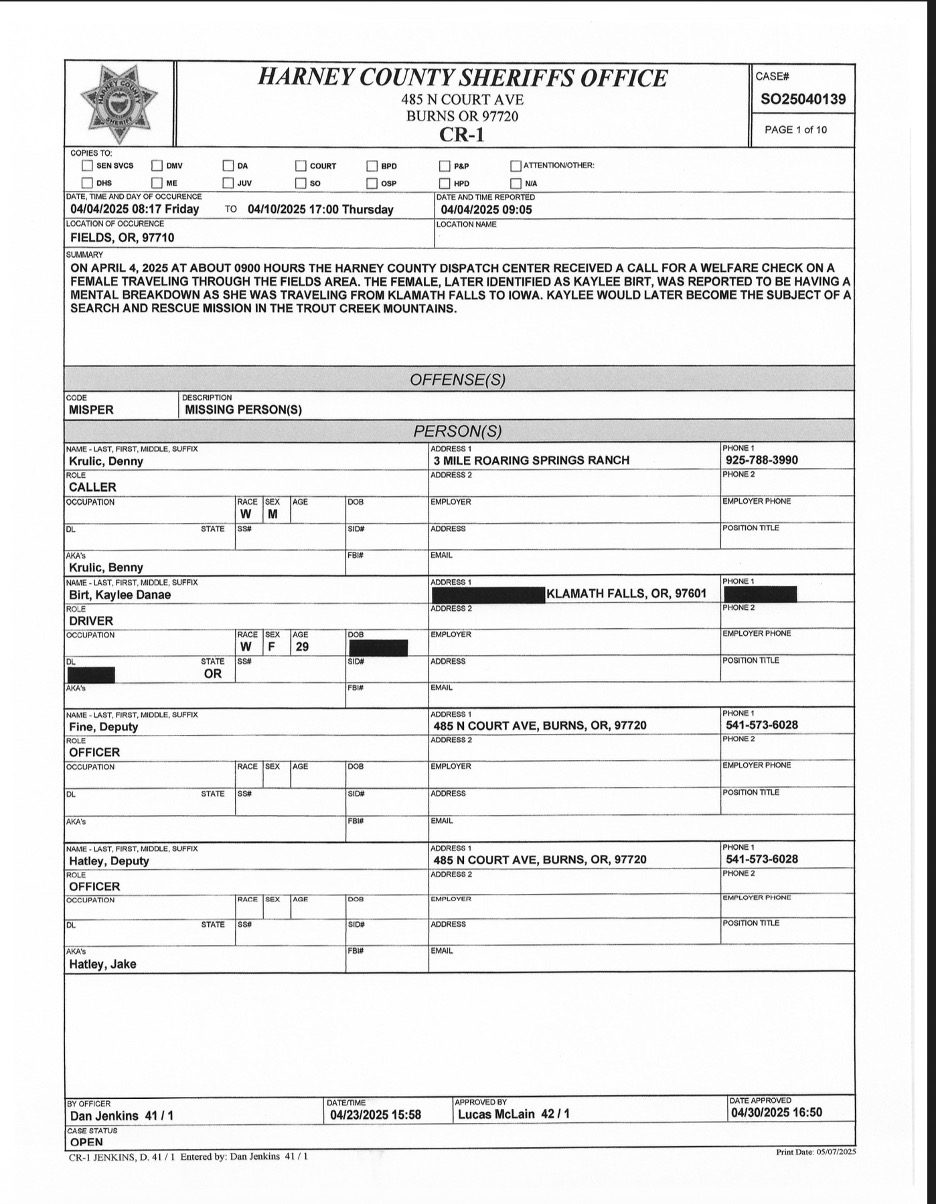
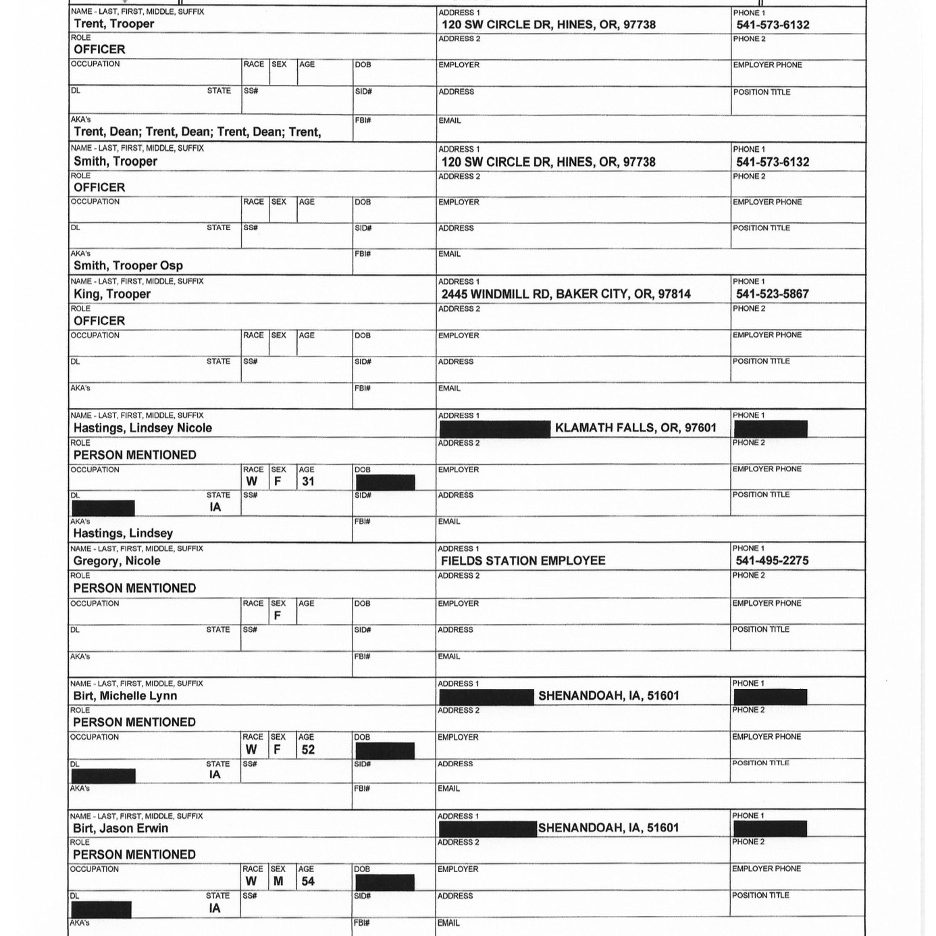
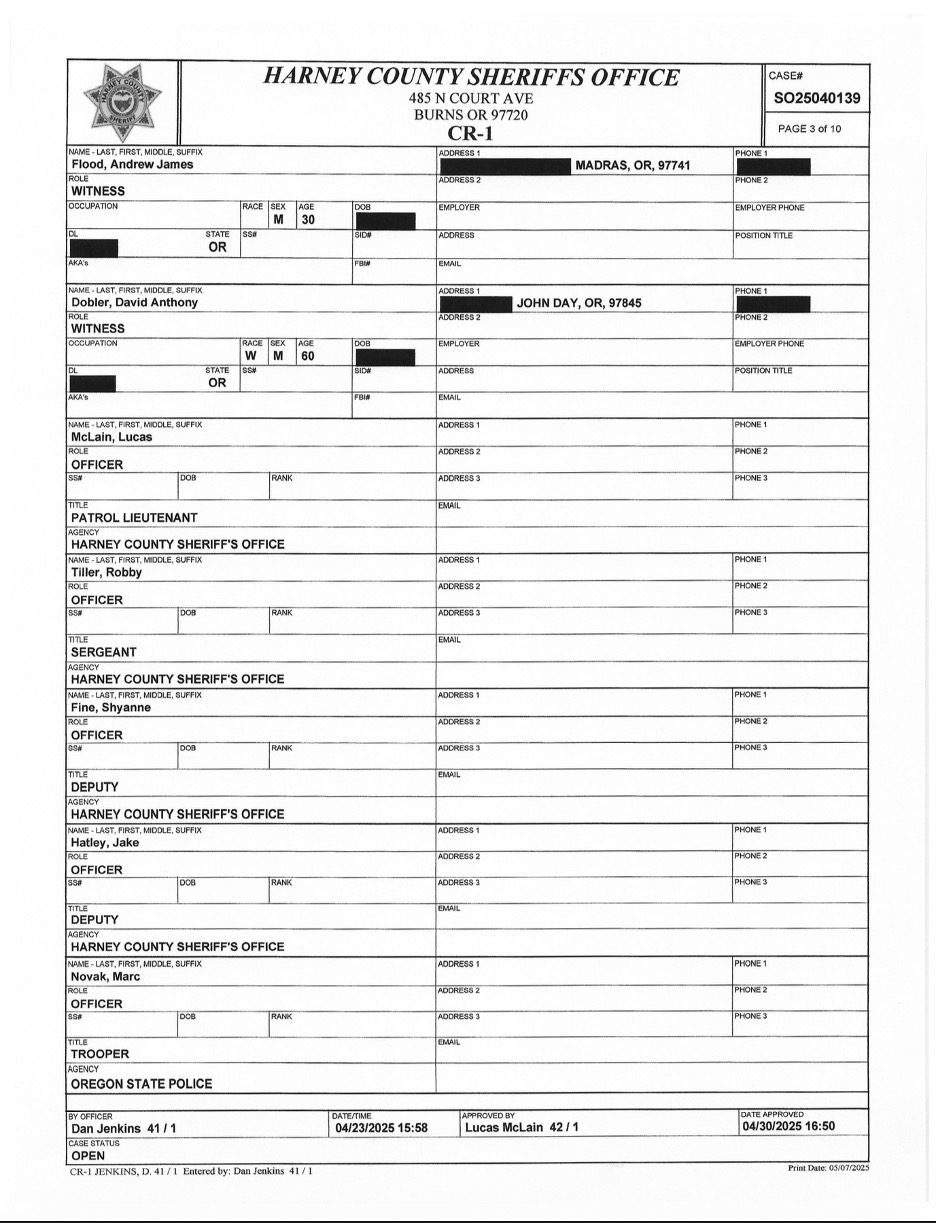
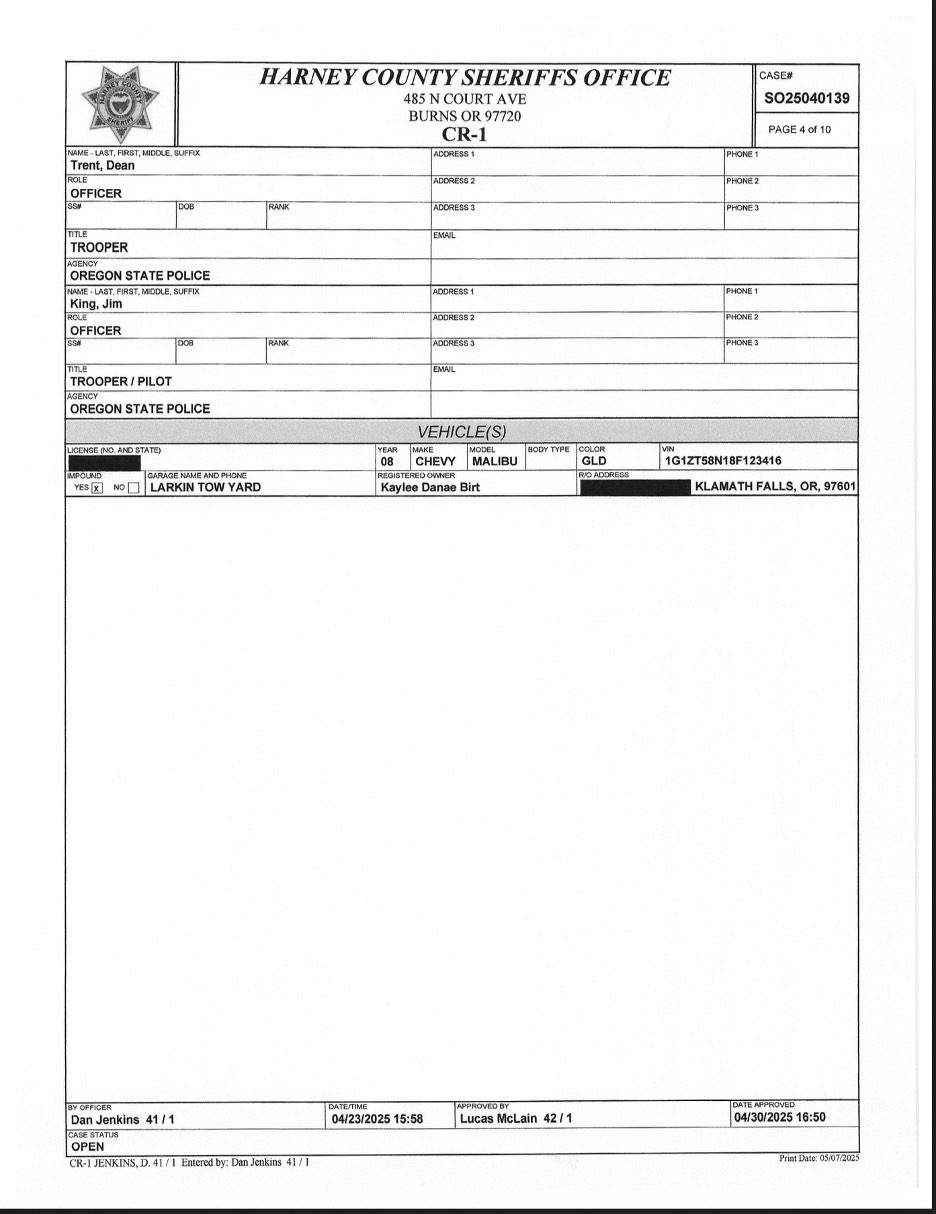
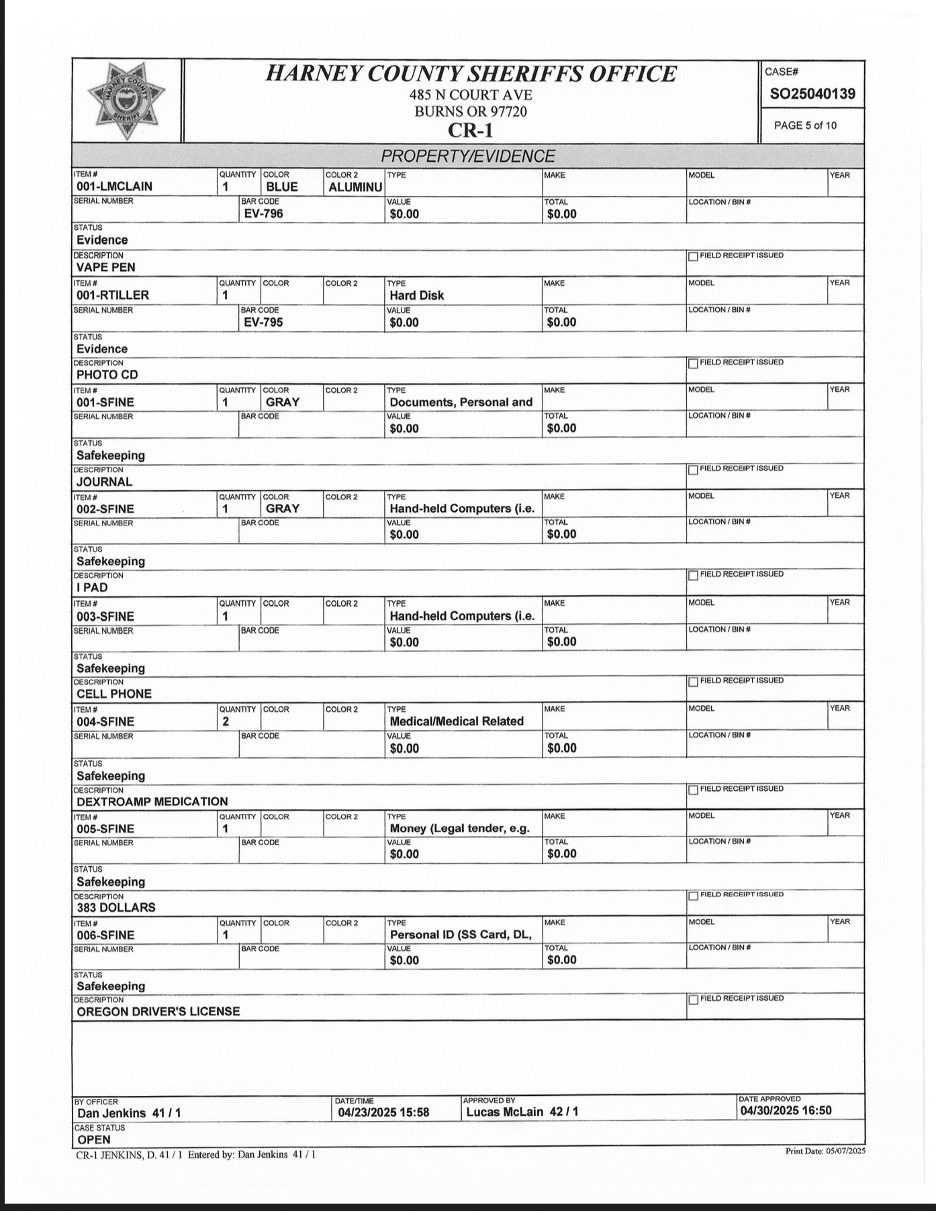
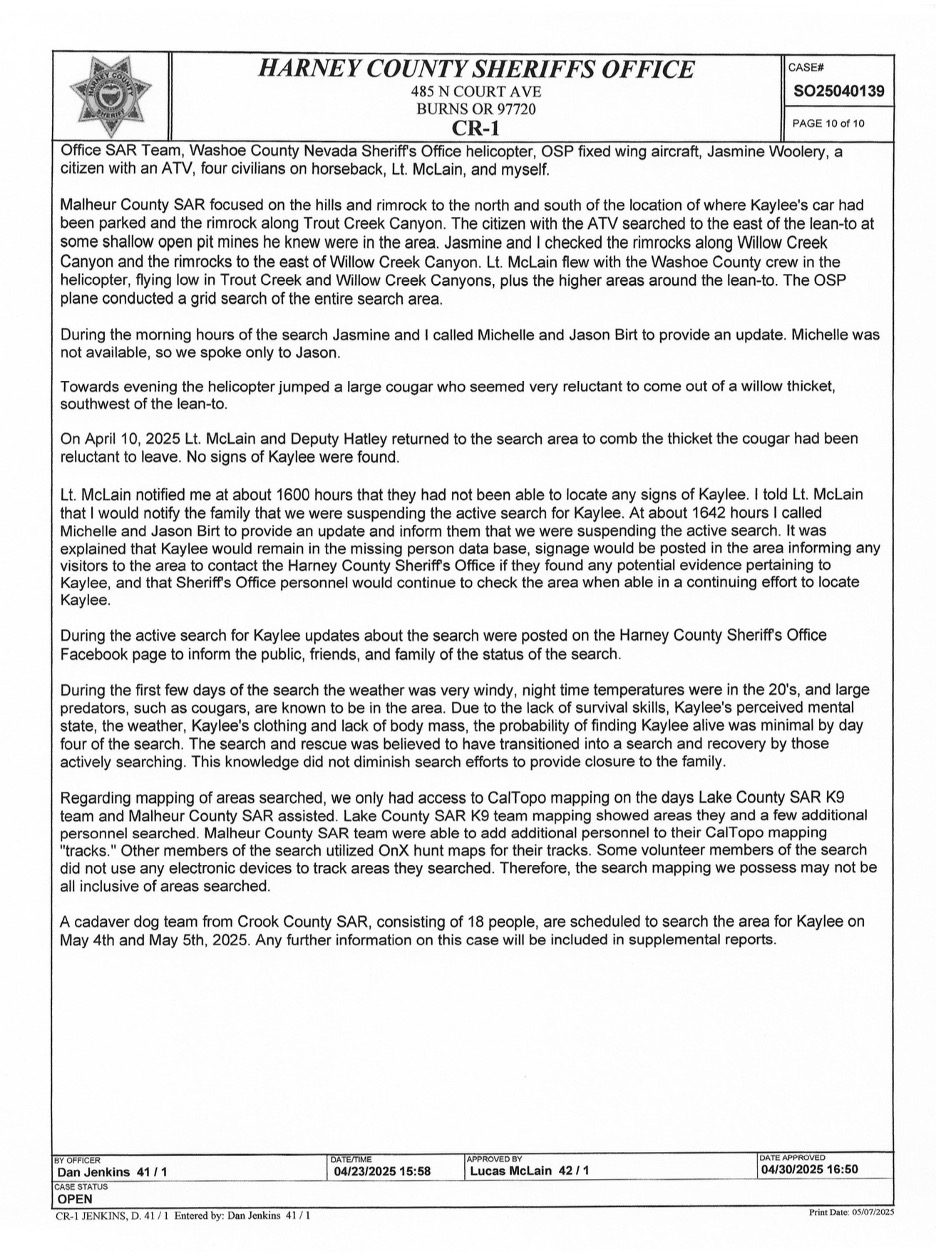
Other reports to follow in Part III