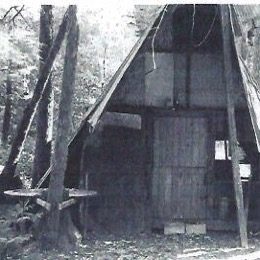
The A-frame
October 16, 1981
The story of Denise and Allen Elson
By Mark Creighton
The thud of Allen’s axe on the damp fir log was loud, vibrating in the heavy October air.
Denise stepped out the side door of the A-frame, wrapping one of Allen’s thick, oversized flannel shirts tightly around her waist. It barely closed over her eight-month-pregnant belly. The mountain air was turning, tasting faintly of decay and winter.
"I'm headed to the river for a bath," she said, her voice instantly swallowed by the surrounding wall of ancient, towering trees. "Do you want to join me?"
Allen didn't lift his gaze. He drove the axe downward with a harsh crack. The quiet between them had grown for months, as unyielding as the Oregon wilderness they relied on.
Earlier, they had begun cultivating marijuana in the isolation of the Sixes River, which had sounded like freedom in the summer. Now, as the cold crept in, the forest felt less like a sanctuary and more like a cage.
Denise touched her stomach as a cold knot of dread tightened. She couldn't raise a newborn here, not in an unheated shack of salvaged lumber. They had agreed to push through the harvest, then flee south to the Emerald Triangle, where their friend Douglas had promised them work. But even that escape route felt poisoned.
Ever since Douglas had visited a few days earlier, Allen had been unhinged. Denise still remembered the raw, wide-eyed terror on Allen’s face as he racked his shotgun and threatened to blow off Douglas’s head if he ever saw him again. Allen wouldn't say why.
"Watch the path," Allen muttered, his voice flat. "The shadows are lengthening."
Denise walked away, escaping the axe’s oppressive rhythm. Her boots sank into the damp, decaying leaves along the trail she had worn into the dirt over the summer. The forest grew denser here. The canopy was so dense it choked out the afternoon sun, casting everything in a sickly green twilight.
When she reached the river, the water was unnervingly low—a sluggish, black vein winding through ancient, water-carved stones.
A massive Douglas fir, torn up by coastal winds years earlier, lay dead across the bank, its exposed root system clawing at the air like a cluster of skeletal fingers. Below it, a stagnant pool had formed. Their special place. Today, it looked cold.
She washed quickly, shivering as the freezing water hit her skin. By the time she stepped out and pulled the heavy shirt back on, the sun had slipped completely behind the mountain ridges, plunging the canyon into an abrupt, suffocating darkness.
When she returned to the clearing, the fire was roaring, but it offered little comfort. The firelight danced along the tree line, casting long, jagged shadows that looked like grasping limbs.
Allen sat on a notched log, staring into the flames. "Denise, I’m getting the deer meat to cook. Come sit down."
Before she could move, a sound cut through the crackle of the wood—the distant, rhythmic pop-pop-pop of tires on gravel.
Up on Sixes River Road, a pair of rusted trucks drifted past the clearing, their headlights carving yellow slashes through the gloom. Denise caught a glimpse of haggard faces pressed against the glass—the remaining commune members from up the mountain, heading toward the Sixes River store. They didn't wave back. They looked like ghosts fleeing a sinking ship.
Denise sat close to the fire, drawing her knees to her chest. "I hope Pooch and Pup don’t come back around here," she whispered, her eyes darting toward the darkness beyond the firelight. "There’s something wrong with him, Allen. He looks right through you."
Allen’s jaw tightened. "He’s a goddamn psycho who escaped from a farm colony in New Mexico after committing murder. If he and Hilary think they can squat under the 80-acre bridge or crash here whenever they want, they're wrong."
"What about Boatman?" Denise asked, her voice trembling. "He was furious when he came by yesterday and told us to clear off his claim."
"I'll talk to him," Allen grunted, though his hand drifted subconsciously toward the shotgun propped against the A-frame wall. "We just need a couple more days."
Hours later, the fire had died down to a bed of glowing, angry red coals.
Inside the pitch-black A-frame, Allen snapped awake.
Beside him, Denise was breathing softly, but outside, the forest was alive with a heavy, deliberate crunch.
It wasn't the light, erratic step of a black bear. It was the slow, deliberate snap of dry brush under a heavy boot.
Allen slipped out of the blankets, his skin prickling with sweat despite the damp chill.
He gripped the cold steel of his shotgun, slipped his bare feet into his boots, and stepped through the side door into the night.
A dense, blinding fog had rolled in off the river, swallowing the clearing whole. He could barely make out his own hands.
"Hey!" Allen’s voice ripped through the mist, laced with sudden, sharp panic. "What the hell are you doing here?!"
Inside, Denise bolted upright in bed.
BOOM.
The shotgun blast didn't ring out; the thick fog muffled it, turning it into a wet, heavy thud that rattled the A-frame's wooden walls.
"Allen?" Denise gasped.
Silence. No footsteps. No shouting. Only the heavy, wet drip of condensation from the trees.
Denise threw on Allen’s long shirt, her heart hammering against her ribs. She threw open the side door and stumbled into the white fog. A few feet from the threshold, her foot struck something soft and heavy.
She looked down. Allen lay face up in the dirt, his blood turning the damp earth black. His eyes were wide, staring blankly into the mist. He was motionless.
A sudden, violent crash echoed from inside the A-frame behind her. Wood splintered, and clothes were ripped off their hooks. Whoever had shot Allen hadn't run away—they were looking for her.
Panic seized her. Screaming in her mind, Denise turned and ran into the blinding white darkness. She didn't have shoes. The sharp rocks and jagged twigs tore at the soles of her feet, but she didn't feel the pain. She only felt the desperate, primal urge to protect the life kicking wildly inside her womb.
The fog was an absolute sensory-deprivation chamber. She couldn't see three feet ahead, but behind her, the woods were erupting. Someone—or something—was tearing through the brush, matching her pace and gaining ground at terrifying speed. There were no flashlights. Her hunter didn't need light to find her.
She hit the river path, her breath coming in ragged, sobbing gasps. The crashing behind her was close enough that she could hear another person's heavy, ragged breathing.
She burst onto the riverbank. The low water offered no escape, but the uprooted Douglas fir loomed in the fog like a skeletal fortress. Denise plunged into the icy pool, the water shocking the breath from her lungs.
Sliding beneath the massive, dead root ball, she squeezed into a muddy cavity beneath the bank, grabbing a thick root to keep from drifting.
She submerged herself up to her chin, biting her knuckles to stifle hysterical sobs. The forest fell completely silent.
Through the fog, a shape materialized on the log above her. It was tall, broad, and dripping wet. It didn't move. It just stood there, head tilted, listening to the dark.
Denise held her breath, her chest burning as the freezing water turned her limbs to ice. A single drop of blood from her torn foot drifted into the black pool.
The figure slowly lowered its head toward the water, staring into the dark recesses beneath the roots. A sharp, terrified scream ripped from Denise’s throat: “My baby!” as a heavy, calloused hand plunged into the freezing water and clamped around her hair. The horrific, echoing shrieks cut through the dense canyon fog, ricocheting off the mountain walls until, with a sudden, sickening splash, they faded into a brutal, final silence. The river rippled, the fog settled, and the ancient forest's serenity returned.
It was 1993, and the Oregon coast was as cold and damp as ever. I was a Detective with the Curry County Sheriff’s Office, primarily assigned to major crimes in North County.
I pulled my unmarked cruiser up to the curb at the corner of Colvin and Moore Streets, right outside the Gold Beach station. It was a routine morning. I took the stairs to the lobby, exchanged a quick, familiar greeting with Shelly, the receptionist, and waited for the familiar buzz of the security lock before pushing the door open.
As I made my way toward the back, one of the dispatchers intercepted me in the hallway and shoved a piece of paper into my hand. “I just got this off the teletype," she said, her voice dropping. "It’s connected to a 1981 missing-person case."
I didn’t read it right away. I gripped the paper, nodded, and kept walking, tossing a quick "hello" to the Sheriff and the Lieutenant as I passed their offices.
Our unit was small—just three detectives sharing one room. I had North County, Boice handled Central, and Gardiner handled South County. As I walked into our shared office, I broke the morning silence with a few of my usual rude-but-funny comments to get a rise out of them, then strolled over to my desk.
Before diving into our own paperwork, the three of us always held a quick morning briefing. We’d review our caseloads, and if anyone was free and a detective needed help, we’d team up. It was a good system, and we worked well together.
Once the briefing wrapped, I finally sank into my chair and smoothed the teletype.
The message came from an outside agency about an unidentified female body they found. The description was a near-perfect match for someone who had vanished from Curry County more than a decade ago.
It belonged to the missing persons case involving Denise and Allen Elson—a couple who had vanished from an old hippie A-frame house on Sixes River Road in '81.
Until that exact moment, I didn't even know the case existed.
Intrigued, I walked over to the old metal file cabinets, pulled out the dusty 1981 case file, and laid it on my desk.
I compared the details of the unidentified body with Denise Elson's records. Based on specific physical characteristics—and the notable fact that the recovered body was not pregnant—I felt a grim certainty. It was not her.
When I reviewed the old case files, the reason the investigation collapsed became horrifyingly clear. The men who came before me didn't just move on—they were systematically dismantled.
The case instantly hooked me. There were too many unanswered questions. Since my duties already required me to head north toward Port Orford that afternoon, I decided to go to that A-frame.
My obsession drove me ten miles east on Sixes River Road, searching for a relic that should have rotted away decades earlier. I found it crouched in the choked wayside: the A-frame.
It was never a home. It was a rotting cage of salvaged, jagged timber, slapped together by the Nonagon cultists in the early '70s—a pathetic shield against the elements. Stripped of running water, heat, or any human comfort, it stood as a hollow, angular skeleton, looming amid aggressive overgrowth.
The moment my boot crossed the perimeter, the forest died.
It wasn’t a gradual fade of sound. It was an instant, violent execution of the atmosphere. An invisible hand had thrown a master switch, snapping the throats of every bird, frog, and insect in unison. The sudden absence of sound hit me like a physical blow.
To my left, a small clearing seemed to choke on its own shadow. A crude fire pit sat at the center, encircled by jagged, toothlike rocks and rings of rotting log cuttings that mimicked tables and chairs. The ash inside wasn't just cold; it was a dead, calcified gray, untouched for an uncomfortably long time—as if time itself had abandoned that patch of dirt.
I forced my way through the dense, clutching underbrush, following a faint, suffocating trail down toward the Sixes River, where Denise and Allen used to bathe and gather water. The river snaked sluggishly around thousands of years of eroded stone, the rocks breaking the surface like a fractured spine of buried skulls.
Then the air temperature plummeted into a violent, localized freeze.
Crack.
A sound like a splintering bone ripped through the silence. From the extreme periphery of my vision, two figures materialized. They weren't just ghostly; they were wrong—smudged, featureless silhouettes standing perfectly rigid in the thicket, staring with a malice that didn't need eyes.
The moment I turned my head to face them fully, they bled back into the brush, leaving only the sickening certainty that I was being watched.
Further down, the suffocating trees parted to reveal a massive, uprooted Douglas fir, felled by some ancient, catastrophic coastal storm. Its colossal root system tore from the earth like a jagged, weeping wound, trapping the river's flow in a stagnant, black pool. This was where they bathed. This was where Denise was erased from existence.
The camp’s only warning system had always been the mountain itself—the unmistakable, rhythmic crunch of gravel and the pop of tires echoing through the peaks long before a vehicle arrived. But today, the road was dead. No cars. Only the anomaly.
The silence wasn't just quiet; it was a stifling weight pressing against my eardrums. My spine didn't tingle; it froze.
I raised my camera with trembling hands and snapped a few frantic photographs. The mechanical click of the shutter ripped through the dead air like a gunshot.
A primal, screaming urge to flee flooded my veins. The trees weren’t just standing there. They were an audience, watching, whispering through a paralyzing stillness that whatever wicked force had violated these woods was now standing directly behind me.
I have returned many times since, drawn by a sick compulsion. The dead quiet is always there, waiting for me to step back into the trap.
The case hadn't been abandoned because of bureaucracy. The forest, or whatever had taken Denise and Allen, had wiped the slate clean. They were all gone, replaced by new blood. Now I was the one taking their place.
Life has many twists and turns, but the woods taught me a darker truth. Humanity is only a thin veneer. When you alter the environment and isolation sets in, the survival instinct mutates—and people will do unspeakable, horrible things just to keep breathing…